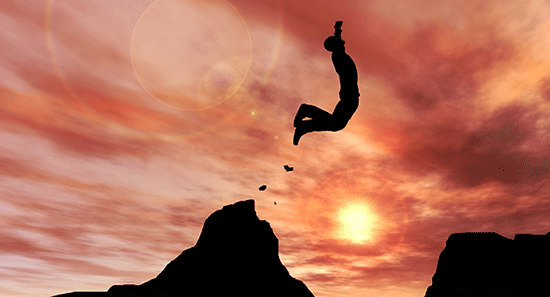
Leap of Faith

leaplarge

It continues to amaze and sadden me to hear people proclaim certainty about their inability to do yoga or Pilates even though they have never tried.  Or maybe they tried many years ago but are sure that the interim time span has zapped their capacity. The time for these efforts has passed, they reason, it’s pointless to try now.  In the next breath, however, I also commonly hear “but I have to do something!”  Well, there you have it.  You can either spend your time wishing you could do something and lamenting your perceived inability or you could spend that same time actually doing something.  Granted, making the effort takes a leap of faith.  It requires overcoming fear and venturing into the unknown.

One thing that might help is to remember those times in the past when you did manage to overcome your fears and venture into the unknown.  We’ve all had those experiences.  Think of a time when you wanted or needed to do something bad enough that you dropped your resistance and moved into it.  No matter what the outcome, I think it’s safe to assume that you learned something from that experience.  And chances are what actually happened is nothing like what you thought might happen.

Another motivation might be to consider the consequences of doing nothing.  You will continue to feel bad about yourself both emotionally and physically.  That negativity can produce a downward spiral.  The mind-body connection between physical illness and emotional attitude is increasingly well-documented.  Yoga and Pilates both work on strengthening that mind-body connection helping you to focus your mind, get to know how your body works and bring body and mind into better alignment.  Why let yourself sink into a rut when all you have to do is take that first step in a new direction.  The first step is the hardest, but once you take it and begin to move forward your confidence will grow and you may find your attitude changing.  After all, others have done it and you can do it, too!

Finally, all of us have friends or neighbors who are doing those things that we wish we could do.  I don’t mean your children or grandchildren or anyone who is half your age or pictured in a magazine.  But others who are in similar situations to your own.  You know who they are.  Ask them about their journey.  They probably do not have any special powers that you lack.  But somewhere along the line they took that leap of faith and tried something new.  Is it working for them?  Will they support you in your effort to try?  Having a system of support is a huge asset when you are trying to make a change in your life.  That’s why classes can be so helpful.  All the others in the class are working at the same thing.  We all need each other to stay on track. Working in a group with the similar goals is powerful.  Take advantage of that and let the group’s momentum pull you along.

So I would like to challenge you to try again to make that leap of faith.  Take your fear to the limit:  what’s the worst that can happen? If you move slowly and thoughtfully, paying attention only to yourself and how you feel, making movements only in a way that works for your body and stopping when you need to you are unlikely to hurt yourself.  You may even surprise yourself by finding that it feels good. Maybe you won’t like it.  That’s fine.  Everyone has to find the form of movement that works best for then.  But we all need to move, regardless of age or physically limitations.  You’ll never be able to form an opinion until you try.

Hope to see you all in a class soon!

The Paradox of Fragility and Resilience

This week I’ve been reflecting on the ironic – maybe even paradoxical – duality of the fragility and resilience of life.  Life in general, but human life in particular.  Here we are:  minute creatures

“all hurtling through deep space on this tiny rock called Earth.  I mean, really, think about it. Protected from the frigid galactic void of the Milky Way but by a blanket of air, held on the surface by gravity, whatever the heck that is, and here we are.”

That quote came from an interview at onbeing.org with Dr. Ira Byock, professor of medicine at Dartmouth and former director of Palliative Medicine at Dartmouth-Hitchcock Medical Center.

It’s nothing short of miraculous that we survive anything.  We are tossed and torn, ravaged by disease, environmental insults, genetic mutations and all manner of plague.  In vain we try to maintain control over our lives – and the lives of others, our children for instance – yet the vast majority of forces in our lives are beyond our control.  This doesn’t even count what we voluntarily do to ourselves and to each other.  Seems like we are constantly inventing new and “better” ways to kill each other.

Still we continue to survive.  We pick ourselves up, find ways to repair or circumvent the damage and on we go.  Not all of us or all of the time.  And not forever.  But the odds we manage to overcome are quite literally amazing.  We all have stories of astounding feats of survival.  Generally, we have no provable (repeatable) explanation for any of them.  Even in the face of known and certain death, we cling to life:  “To life, to life, l’chaim”, sings Tevia in Fiddler on the Roof, even as he and his family and friends are being forcibly and violently ousted from the home they have known all their lives.

The following is a quote from another On Being interview.  This one with Dr. Sherwin Nuland, author of How We Die, referring to the inner workings of human beings:

“Here are these 75 trillion cells, and every cell has hundreds of thousands of protein molecules in it and they are constantly interacting with one another in what would appear to be chaos. And in fact, if you were to be able to lower yourself into a cell, you’d be terrified because it would seem so chaotic. If it had sound, you couldn’t live with it, it would be so noisy. And yet what is actually occurring is that these reactions are all counteracting threats to the survival of that cell. And I think that there is within the human organism. . . . an awareness of the closeness of chaos.”

Closeness to chaos.  Hmmm . . .  Yet Dr. Nuland goes on to say, “we are greater than the sum of our parts . . . our brains [have] developed a capacity for spirit, for seeking lives of integrity and equanimity and moral order.”

Resilience in the face of chaos.  Resilience despite the fact that we keep coming up with new and better ways to kill each other.  Resilience even when there are others all around us with whom we disagree.  All those disagreements seem kind of silly now, don’t they?  If they don’t, they should.

If you read through these blog posts, you may notice an ongoing thread – namely, ways in which we can at least try to maintain that resilience.  Our lives may be mystery, but one thing we do know is we will be here on this planet for a short time only.  We don’t know what’s going to happen during that time, but we can make some choices about how we spend that time.  If we avoid attaching too much significance to outcomes and just focus on process, we might even have a shot at being happy with our choices.  Following is from a recent Yoga Journal post:

“Think about it—you are capable of balancing the weight of your torso on two long supports, while smoothly transferring this weight from one support to the other, and all while maintaining a constant rate of motion and perfect balance. This simple motion requires the perfect coordination of hundreds of muscles large and small across your entire body. And that’s just walking!

The human body has over 600 muscles, many of which are too small, or too deep inside the body, for us to see. Hundreds of tiny muscles across the body work constantly to maintain our balance, stability, and precision of movement—all vital qualities for a healthy yoga practice.

Take a moment today to appreciate the amazing feats of coordination your body accomplishes in even the simplest of acts.”

Having recently had surgery I am intimately re-acquainted with the remarkable abilities of my own body, despite the abuse I’ve subjected it to.  Just think – I was knocked unconscious, cut open, kept alive by machines, had my insides extracted, etc.  Yet here I am writing this blog – alive and well (relatively, anyway).  Then in addition to those assaults on my body, I am having poison injected into my veins in an effort to kill rogue cells and, so far, I’m surviving that, too.  Pretty incredible stuff.  But it happens every day.  Sure, things go wrong.  None of us are perfect and, remember, we are fragile.  But still we take these chances, venturing into the unknown, because we believe that things can also go right.

So as you make those choices about how to spend your limited time here on earth, perhaps you might want to give some thought to focusing on and building your resilience.  Keeping mind and body strong, whatever that might mean for you as an individual, could be one way to do that.  The effort you make probably can’t hurt and it just might help.  If nothing else, it will bolster your confidence in your ability to handle the many challenges that life is going to throw at you, whether or not you’re prepared.