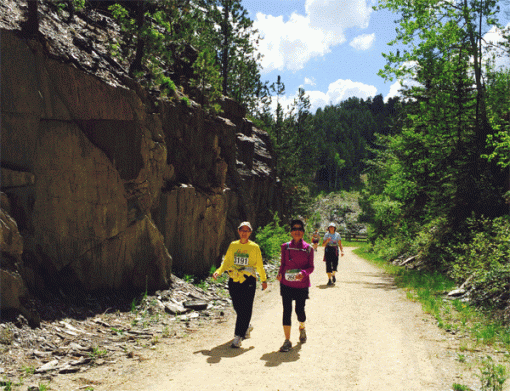
Set an Example and Improve Your Health

From the Office of Disease Prevention and Health Promotion at health.gov, here are just a few proven health benefits of physical activity:

  • lower risk of a wide range of chronic conditions including heart disease, high blood pressure, and diabetes;
  • prevention of falls; and
  • improved cognitive function among others.

Some more good news:  the health benefits of physical activity are independent of body weight.  So it doesn’t matter if you perceive yourself as overweight or underweight. You will still benefit from exercise even if your weight doesn’t change. Frequently I hear people say “I need to lose some weight before I can come to your class”.  My advice – come to class whatever your weight, size or physical limitations.  There will be a way to adapt the exercise to your physical status whatever that is and your health will benefit.  In fact, I would even go so far as to say that if you keep the effort consistent over a period of weeks you will notice changes in your physical abilities and the way your body feels even if you don’t lose weight.  You may notice, for example, that your clothes fit better or you may see other changes in your appearance.  For many years there has been an ongoing discussion in the fitness industry as to whether it is better to be physically fit and overweight or unfit and thin.  My own opinion is that fitness and good health comes in all shapes and sizes.  Despite the physical form that our culture may revere as ideal, good health is far more important than measuring up to some myth of perfection.  Through the ages and in different cultural contexts there have been many variations in what is viewed as an ideal appearance.  Regardless of these fickle and changing perceptions, good health is indisputable.  We have all heard the expression “without good health we have nothing.”  All you need to do is get sick and you will see the wisdom in that sentiment.

Turns out, too, that you don’t need great amounts of high-intensity activity to experience these benefits.  Also, according to studies, the benefits of physical exercise outweigh the risk of injury.  It is not necessary to run a marathon or climb Mt. Everest to be healthy.  The importance of avoiding inactivity is so critical that even small amounts of exercise can yield significant benefits.  Reductions in risk of cardiovascular disease become evident with as little as 150 minutes of physical activity weekly.  Two classes per week will give you that much. And even better results can be seen with 200 minutes per week.  So add 50 minutes of walking per week (which can be broken down into two 25-minute segments, for example) and you are well on your way to better health, improved mood, reduced stress, enhanced endurance and numerous other improvements in quality of life in general.  If you commit to 6 weeks of consistent activity you may find that you actually begin to like it!  Make it a part of your life.  The benefits will continue to accrue and you may begin to notice a difference in how you feel about yourself.  In addition, you will experience improvements in your ability to perform everyday tasks like putting the groceries away and keeping up with your children or grandchildren. The strength, flexibility and balance training provided by yoga and Pilates will also help prevent falls, keep your bones strong, improve your posture and keep your muscles and joints pliable and functioning.

We have so little control over most of the events and circumstances that impact our lives.  So it becomes more important than ever to take control of what we can control while we can control it.  From that point of view it should be a no brainer to do what you can to improve your health, especially when that involves something as simple as adding more movement to your life.  It does involve a daily decision to make that choice.  But if you can’t do it for your own benefit, do it for those around you.  There lives will also improve by the example you set.

More on Exercise and Aging

This week I read an article asking the question “Do We Expect Too Much of Our Bodies as We Age?”  You might read that title and think it gives you a license to get complacent.  “Yup”, you might think, “I’m too old to do ____________ (fill in the blank) anymore.”   But the article presents a different picture.  It is for all of us over-achievers who keep comparing ourselves to each other and to our former selves.  The article discusses our hope that we can reverse (cure?) the aging process by exercising.  This naturally creates frustration with the limitations we continue to encounter as we age.

The fact is, we are all aging.  Every day we get a little older, like or not.  Despite the fantasies of science fiction writers, time only moves in one direction as far as we know.  And with that direction, change happens.  None of us like change. Yet change is inevitable and constant.  One of the few constants in our world – like death and taxes.

So we know we’re getting older and we know we can’t do some of the things we used to do.  Or at least we can’t do them in the same way we used to do them.  So what are our choices?  We can sit and lament the things we wish could still do and beat ourselves up for our own incompetence.  Or we can celebrate the things we can still do.  Some of that inevitable change can be positive.  No matter how much you’ve lost, you can still make gains.  Maybe you won’t get back to where you were when you were 20, but you can improve.  All it takes is a little effort.  The more consistent that effort is, the more gains you will make.

According to the National Institute on Aging, it’s never too late to start and the benefits are numerous and ongoing.  Here are a few:

Being physically active can help you continue to do the things you enjoy and stay independent as you age.  . . In addition, regular exercise and physical activity can reduce the risk of developing some diseases and disabilities that develop as people grow older.  In some cases, exercise is an effective treatment for many chronic conditions. For example, studies show that people with arthritis, heart disease, or diabetes benefit from regular exercise.  Exercise also helps people with high blood pressure, balance problems, or difficulty walking.

In fact, “in most cases, you have more to lose by not doing anything.” (from “Exercise & Physical Activity – Your Everyday Guide from the National Institute on Aging”).  Consistency is the key, though.  Start slow and give yourself time to adapt.  Your muscles make gains from the rest between exercise sessions.  That’s why we sometimes get sore when challenging our muscles.  But that’s how your body gets stronger – by recognizing the need to address the new challenge.  To sustain those gains we need to create that muscle memory.  The best way to do that is like any other memory we want to promote – that is, by providing reminders.  In this case, reminders come in the form of continuing to engage in these activities.  That’s why we call it practice.  The more you do it, the better you get at it.  But getting better doesn’t mean becoming 20 again.  Start where you’re at and move from there.  Fighting with reality will only make you miserable.

Returning to the National Institute on Aging, it’s never too late to start.  Even if you have difficulty, you can still benefit from exercise and movement.  The four types of physical activities recommended include those emphasizing endurance, strength, balance and flexibility.  The good news is both Pilates and yoga incorporate all of the above.  Both disciplines can also be easily modified to accomodate physical limitations.  Also, both will help with whatever other physical activities your life requires – like climbing stairs or gardening or putting the groceries away.

So don’t wait . . . just get moving!  You can do it!  But be kind to yourself.  Compassion begins with yourself.  Idea Fitness Journal recently printed an article on “How to Help Middle-Aged Women Improve Body Satisfaction“.  One reader (Karen Geninatti of Geninatti Gym and Fitness in Carlinville, Illinois) responded to this article by describing her “no negative comments about yourself” rule in her classes.  She also tells participants “never to say anything to themselves or about themselves that they would not say to their son or daughter”.  Amen to that.