Maintaining Motivation

A recent article in the Yoga Basics newsletter cited “Five Things to do Every Day for You”.  First on the list – as it should be in my opinion – is “Move Your Body”.  The prescription is no more specific than that.  It doesn’t need to be.  Any kind of movement, any length of time, or any intensity will fill the bill.  You can walk outside or around your house, take a class or just get up from your desk, chair or bed and stretch for 5 minutes or so.  At first a myriad of excuses may arise:  I’m too tired; it’s too cold outside; I’m in a hurry; I’ll get sweaty and mess up my hair; I need to do x, y or z first (which, of course, is more important); and so on.  You know the drill.  Everything takes precedence over the things you need to do for yourself.

When this happens it can be useful to take an honest look at why it is so difficult to maintain the motivation necessary to prioritize your own needs.  You know that if you ignore your excuses and move anyway, you always feel better.  In fact, whatever movement you choose usually feels so good that the 5 minutes or so you were going to allow yourself quickly turns into 10 or even 30 minutes.  The class you were going to walk out on if it felt too hard suddenly isn’t that bad.  In fact, you may even find yourself making moves you thought were beyond your skill level.  Why is that so difficult to remember?

There are many obstacles that can arise when we set goals and try to accomplish something.  Some of them are genuine circumstances beyond our control that arise without prior notice.  But some obstacles are ones we create.  In fact, there are times when it is hard to tell which is which.  After all, there really aren’t that many things we can control yet somehow we still manage to live our lives.  Still it’s easy to blame our own lack of inner resolve on some external circumstance.  Mostly, though, it’s really a matter of prioritizing. When in doubt it helps to stay motivated.  If you find yourself consistently confronting obstacles in the way of your plans to exercise, maybe lack of motivation is the real problem.

So what can we do to regain motivation?  First thing you can do is remind yourself why you want to move in the first place.  Maybe you want to overcome some chronic pain.  Or perhaps you’re trying to lose weight.  Is there a trip you are planning or an event that would be more fun if you were in better shape?  How about a walk for charity that you would like to complete?  Can you remember how good you used to feel when you moved regularly?  You can get there again.  You can’t turn back the clock, but you can feel better than you do right now.  A repeated mantra in this blog is that the more you move, the more you want to move, and the easier it becomes to keep moving.  It doesn’t happen overnight, although you might feel better right away once you get started.  But the key is practice and consistency.  Don’t give up.  Let others help you.  If you take a class, the other participants will support you.  Find a friend to walk with.  Or walk your dog.  Or walk someone else’s dog.  There are always dogs in need of walking.  Make it easy and fun!

When we’re young, time seems endless and unlimited.  But as we age we begin to recognize the importance of using our time wisely.  In this case “wisely” means using time in ways that will contribute to your overall well-being.  When you feel good, everyone around you benefits.  So you needn’t worry about the others in your life.  Just focus on yourself.  If you want to bring more movement into your life but can’t manage to make it happen, you will feel bad about yourself.  Whatever condition you’re trying to overcome won’t get any better.  This is not a contribution to your overall well-being.  Remind yourself that the time you take to move your body is a small amount that won’t be missed later in the day.  But that small investment will eventually yield a big reward.  That’s certainly a carrot you can dangle when you need motivation.  It’s never too late.  If you can move and breathe you can improve.
Accepting Your Limits

acceptinglimitsmhpyopti
Accepting Your Limits

By Peg Ryan
Mile High Pilates and Yoga
September 3, 2016

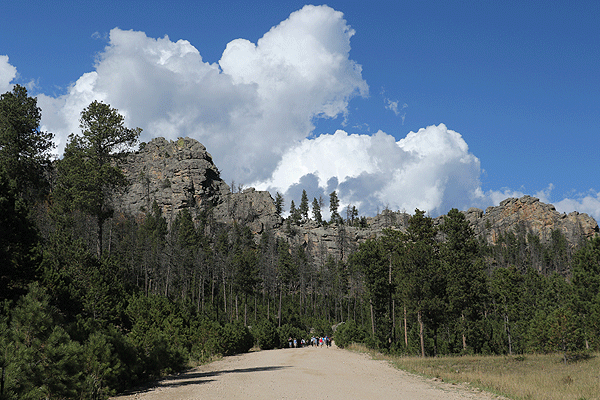
Custer, SD – Today I made the trek to the mountain carving celebrating the Native American hero, Crazy Horse.  It was a glorious day with full sunshine, bright blue sky and all the fall colors accenting the landscape.  This is a bi-annual Volksmarch held at the Crazy Horse Memorial.  It is an opportunity to hike through the extensive monument grounds and eventually reach the carving itself. The hike attracts a wide variety of participants – young and old, experienced and occasional hikers, families, solo walkers and all different shapes, sizes and fitness levels. Having completed this hike many times I have heard all kinds of stories.  One year I spoke with a gentleman who said he has done the hike annually for many years, but this is the only walk he does all year.  Despite steep and rocky up and downhill sections, I have seen folks pushing baby strollers (discouraged in all descriptions of the event) and hauling protesting toddlers.  Fortunately this hike is pretty forgiving. It is well supported with four aid stations featuring water and munchies, strategically placed port-a-potties and several road access points where a walker in trouble could easily change his/her mind and bail.  Many of the other places I have hiked are not quite so inexperience friendly.

It is a wonder to me how many people discount natural conditions in favor of their own inflated sense of ability.  In comparison to the unpredictability of nature, each of us is a tiny member of a large, diverse planet.  Yet we seem to have a view of ourselves that can eclipse our actual relationship to natural surroundings.  Some of the younger hikers who regularly engage in other physical activities can probably manage the challenges of terrain and even unexpected changes in the weather and still come out OK.  But the number of times I have seen people start a 6 mile hike up a mountain after 3:00 in the afternoon with no water or other supplies, improper footwear (e.g., flip flops) and small children in tow never ceases to amaze me.  Sometimes people hear the distance for the event (in this case about 6 miles total) and think something like “Six miles is not that long;  I can do that” forgetting that it may have been weeks, months or even years since they walked 6 miles before and ignoring the challenges of climbing a mountain under today’s circumstances whatever they may be.  Another complication in this instance is that the hike begins at an altitude over 5,000 feet and continues to about 6,500 feet above sea level.  People come from all over to hike this course.  Many are not accustomed to the altitude.  Even experienced and well-equipped hikers can get in trouble when altitude increases or the weather turns bad.

Similarly, when I was running ultramarathons I was amazed by the number of people I spoke to who said they jumped into the race without any preparation and then wondered why they were having such a hard time.  Once a man told me that his only training for a 50-mile foot race was some pool running.  Needless to say he was struggling to complete the race.  Hopefully he managed to avoid any permanent damage, although I’m sure he was hurting for at least the next few days if not longer.

All of this is not to say that one should never challenge oneself.  In fact, setting challenging goals can motivating.   Maybe you have a bucket list of activities you would like to accomplish such as climbing a Colorado 14’er or other mountain, or hiking to the bottom of the Grand Canyon, or bungee jumping, or white-water rafting.  Completing an item on your list can be a source of great satisfaction and accomplishment.  But ideally it should be the culmination of a plan.

There is an interesting article called “Making Friends with Stress” by John Berardi, PhD that distinguishes between “good” and “bad” stress. Some forms of stress can help you build strength.  For example, when you increase the stress on your system by adding distance, speed or endurance as part of your training plan your muscles begin to adapt to the new load and enable you to manage more stress with greater ease.  A problem arises when the load is increased too quickly and insufficient recovery time is incorporated.  Many people are surprised to learn that strength gains are accomplished during the rest period – not the work period.  This is why it is always wise to allow time in between particularly intense workouts.  For example, it is usually recommended to lift weights every other day instead of every day so that your muscles have time to recover and adapt to any changes in the work load.  If you jump into a strenuous race, hike or competition without preparing your body, you’re letting your ego rule the roost instead of acknowledging all of the internal systems in your body that need to be working properly for optimum performance.  And preparation you did last year or ten years ago simply won’t serve you today.  Rest is a good thing.  No matter what form of stress you are subjecting yourself to, you need to allow time to rest.  Your body will not perform properly if you don’t.

So go ahead and challenge yourself, but acknowledge reality.  It is never too late to improve your conditioning, but you might have to modify your goals.  For example, instead of deciding to summit Mt. Everest at age 65 when you have done no climbing above 6,000 feet might be a bit too ambitious.  Setting your sights a bit lower (maybe Harney/Black Elk Peak might do for openers) doesn’t mean you’re a failure. It simply means you are in the moment, accepting who and what you are today rather than wishing you were in some other time, place or body. Then train for the event.  Condition your body so that it will accept the stress.  If you decide that you still want to tackle Mt. Everest, recognize that even if you have to stop you have still achieved success.  Acknowledging your limitations is a sign of maturity not weakness. You didn’t give up – you tried your best.  No matter what it is you want to do, that is what success is all about.  Ask for help when you need it and recognize when your body has had enough.  Severe injury might take you out of the game altogether.  Be kind to your body and it will give you another chance.

When you’re ready, though, go for it!  If you’ve done the training, let go of your fear and trust your training.  Last year my dear cousin who has been plagued for years with rheumatoid arthritis made it all the way to the top of the Crazy Horse carving.  It was a major accomplishment.  But she was ready for it and, although it was difficult at times, she could trust her body to do what she had prepared it to do.

One more thing:  restorative yoga is always appropriate when your body and mind need rest.  Gentle movements are great recovery tools. Nourish your body and mind.  And don’t forget to have fun!